
01
Set the frame
You define scope, processes, sites, products, interested parties, and requirements that affect food safety.
AmpliFlow gives you a guided ISO 22000 project and a tool where controls, actions, nonconformities, and follow-up happen in daily work. Requirements are met through the way people work.
Note: AmpliFlow can issue a project statement showing that your ISO 22000 work is underway. It helps you show customers and procurement teams that you are on the path to certification before the certificate is ready.
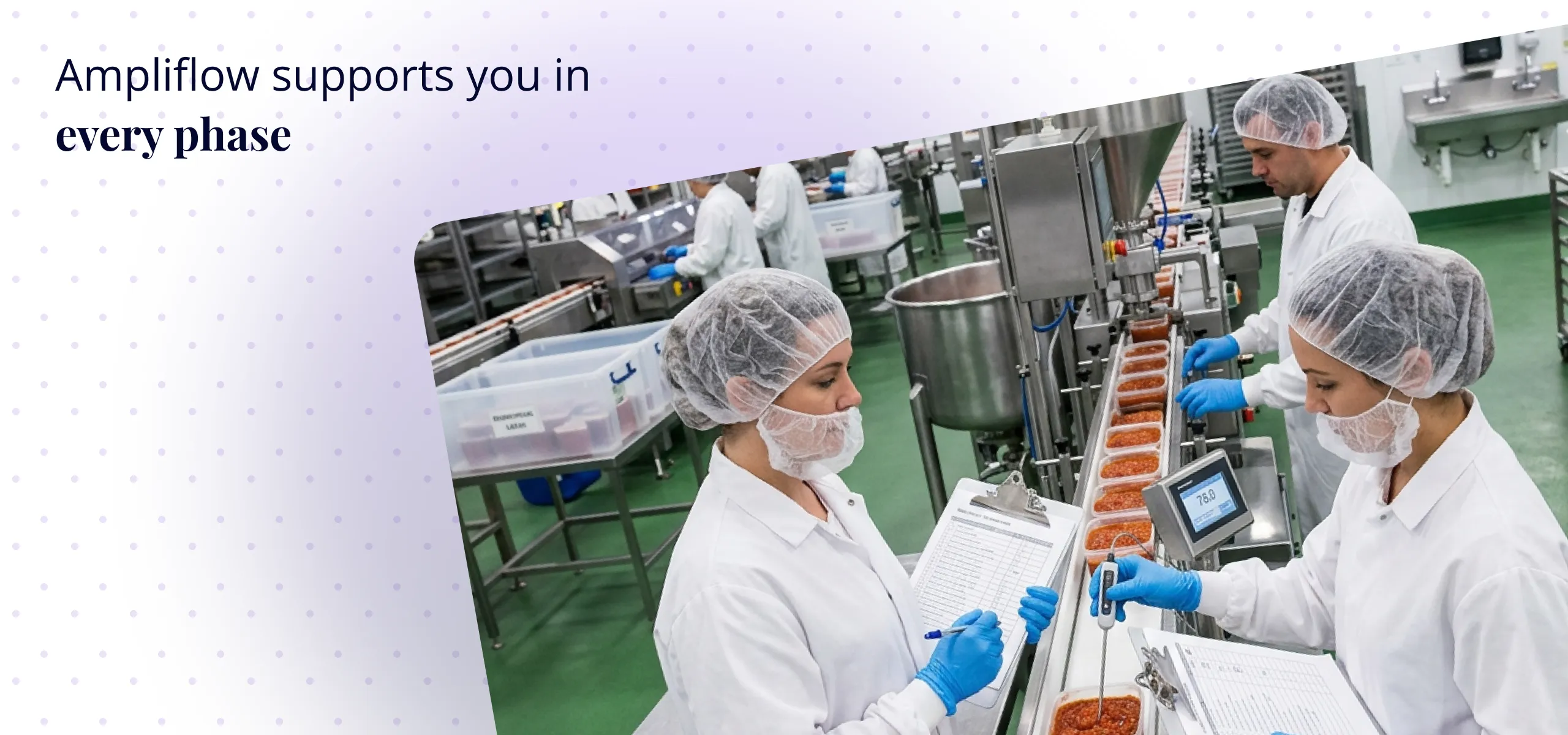
Used by companies that want management systems, risks, and follow-up to work in daily operations.


The goal is still ISO 22000 certification. The difference is that the work does not stop in documents. You build a system where food safety, ownership, controls, and improvements can be followed up continuously.
Wrong path
Many teams have strong food safety knowledge, but the work is spread across paper, Excel, email, and folders. Then traceability, nonconformity follow-up, and living routines become harder between audits.
Right level
You need structure for PRPs, hazard analysis, HACCP/OPRP plans, controls, traceability, competence, and corrective actions. But the structure must be simple enough for the people who do the work.
Smart choice
When the ISO 22000 project happens in AmpliFlow, what you build for the audit is also what you use afterwards. Controls, nonconformities, documents, ownership, and follow-up stay connected in one platform.
AmpliFlow is not just a place to store ISO documents. It is the platform where you lead the work. Projects, processes, routines, risks, checklists, nonconformities, competence, audit, and management review connect.
The platform in practice
Here we show a few parts: projects, temperature controls, routines, overlapping standards, and checklists. It is a sample, not the full platform.
You do not build everything at once. Start with scope, ownership, and processes. Then add PRPs, hazard analysis, controls, traceability, and follow-up. Each part gets a place in AmpliFlow so the system stays usable after the audit.
You define scope, processes, sites, products, interested parties, and requirements that affect food safety.
You gather prerequisite programmes, product data, flow diagrams, hazard analysis, and the hazard control plan in a controlled structure.
You make monitoring, values, checklists, nonconformities, and corrective actions traceable.
You follow up objectives, competence, internal audit, management review, and improvements before certification.
The list shows the tools used in the ISO 22000 work and support tools we usually recommend. At the end, all selectable support tools and tools from other standards are available when you build further.
22 tools in this setup
Add support tools or tools from other standards. When a tool is tied to an ISO requirement, the standards are shown on the card.
AI controls, justifications and status
Map environmental impact
Risk assessments and safety rounds
We can run certification projects for ISO 22000 or several standards directly in AmpliFlow. When you build in the same platform, you get an integrated management system instead of parallel ISO tracks.
Mostly self-driven
For teams that have food safety competence internally, but want the right start and AmpliFlow as the backbone for the system.
Balanced internal work and support
For teams that want more support, clear project leadership, and help prioritising the right parts of ISO 22000 in the right order.
Most support through implementation
For teams that want the most help with structure, workshops, training, follow-up, and audit preparation.

"AmpliFlow, which knows both management systems and IT, is a perfect partner. They helped us create a smooth and logical structure with exactly the IT tools you need to go through a certification audit."

You can discuss your situation, ask your questions, and see which path fits best. If you want to continue, you get a clear proposal. No pressure.