
The management system is built directly in the platform you will use after implementation.
ISO certificationDigital management system + certification support
ISO certification without document chaos.
Choose the standard, get the right support, and build the management system directly in AmpliFlow. Less document chasing, clearer ownership, and a way of working that lasts after the audit.
- Standard: ISO 9001, 14001, 27001, 45001, 22000, or 42001.
- Start: We help you choose level, plan, and first steps.
- Optional: Combine several standards in one system, such as ISO 27001, 45001, and 14001, or start with one and add more later.
The foundation in every package
AmpliFlow, setup, templates, and a shared introduction.
You start with a prepared structure and templates for the practical work.
We show you how to use the software and templates before the work begins.
Used by companies that want a management system that still works after the audit.






More than a certificate
You came looking for certification. You found a smarter way to run the company.
ISO easily turns into a document project.
The work ends up in SharePoint, Excel, and email threads. The audit may pass, but daily operations do not improve.
You need a system where the work actually happens.
Processes, ownership, goals, risks, nonconformities, and follow-up should be easy to use, not something you pull together before an audit.
Certification becomes the receipt for a way of working that already exists.
When you build in AmpliFlow, you do not just get better audit evidence. You get a management system that still works after the audit too.
File migration is included
We help you move the files into AmpliFlow
File migration is included at no extra charge. The files may be in SharePoint, on a file server, or in an older system.
We review where the files are and which ones should move. Then we move them into AmpliFlow.
How to switch to AmpliFlow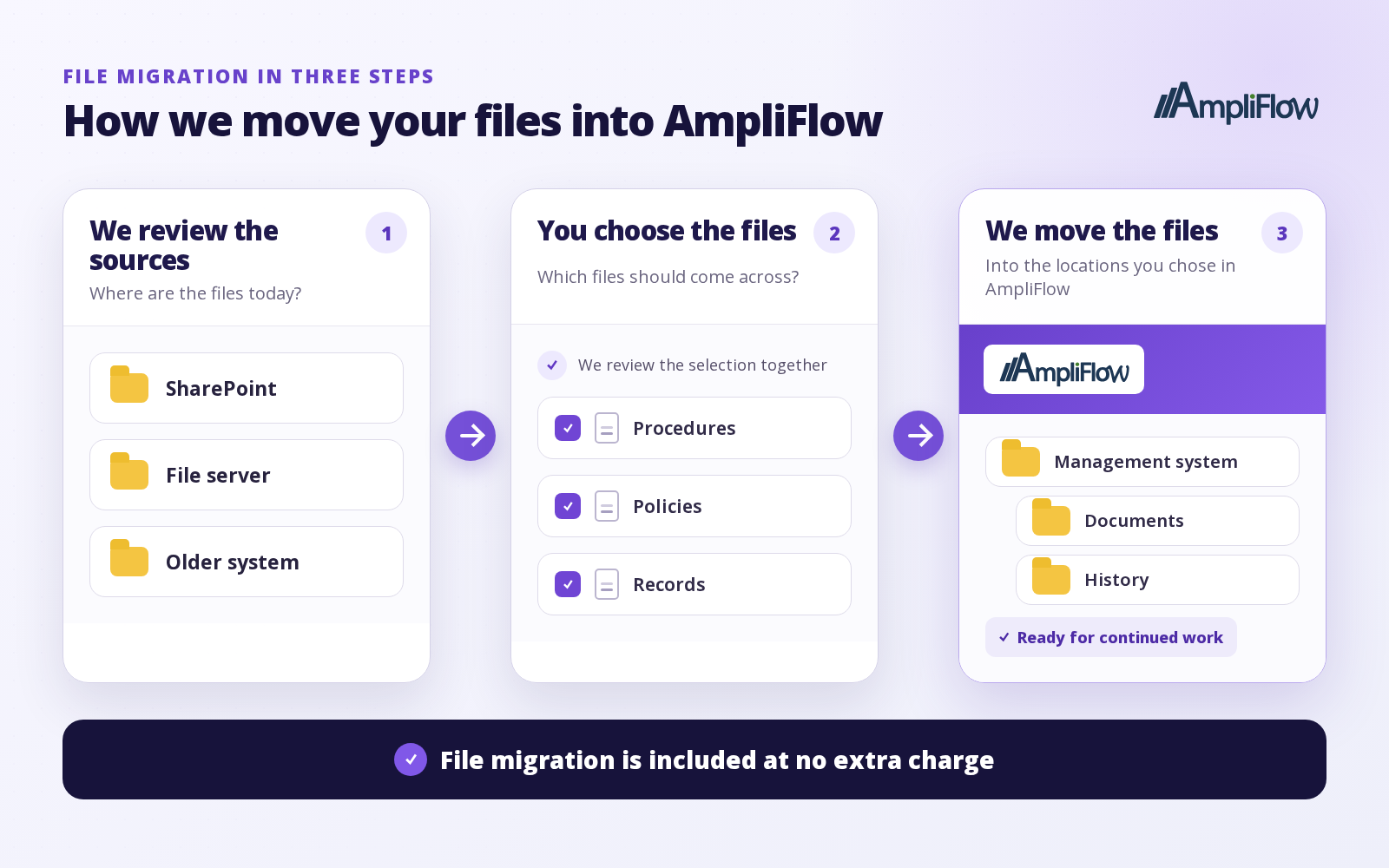
The platform in short
What you need to show at the audit
Risks, controls, actions, processes, and decisions need to connect. Here are three examples of how AmpliFlow brings that work together.
Risks become actions with owners
Assess risks, create actions, and follow up what is done without moving the work into Excel.
Controls show what has been done
Checklists, controls, and nonconformities create audit evidence while the work happens, not in the weeks before the audit.
Projects and processes get clear status
Implementation work, process maps, and management review connect to owners, decisions, and next steps.
Next step
Which standard should you start with?
Most companies start with one standard. Many add more later. This helps you choose the best first step.
Common certification tracks
ISO 9001
QualityFor companies that want better quality control, ownership, customer requirements, and improvement work.
Read about ISO 9001 →ISO 14001
EnvironmentFor companies that want practical environmental work with aspects, legal requirements, goals, and follow-up.
Read about ISO 14001 →ISO 27001
Information SecurityFor companies that need risks, controls, accountability, and proof in one ISMS.
Read about ISO 27001 →ISO 45001
Health & SafetyFor companies that want risk assessments, safety rounds, incidents, and actions in the same system.
Read about ISO 45001 →ISO 22000
Food SafetyFor companies in the food chain that need HACCP, PRPs, controls, and traceability in one place.
Read about ISO 22000 →Specialised standards in the same platform
One platform, more than one standard
Build an integrated management system, one standard at a time.
ISO standards share the same foundation. That means you can reuse processes, risks, nonconformities, goals, and follow-up when you expand later.
Shared processes
One process can cover requirements from more than one standard. You do not need to rebuild everything when you add the next one.
Shared risk management
Risks live in one register, linked to the right standard, the right process, and the right action.
Shared nonconformity handling
A nonconformity is recorded once and stays traceable through root cause, action, and verification.
Easier to expand later
When the core structure is already in place, the next standard becomes an extension step, not a new side project.
Mini, Midi, or Maxi
Choose how much of the implementation you want to lead yourselves
Every package includes AmpliFlow, system setup, file migration, templates, and an introduction to the software and templates. The difference is how much support you get with project leadership, internal audit, training, and adaptation. Every level requires management involvement and an internal owner.
Mini
You lead and carry out the work yourselves
For teams with an internal project lead that want to build the management system themselves on a ready-made foundation in AmpliFlow.
Included
- AmpliFlow software
- System setup
- File migration
- Templates
- Introduction to the software and templates
Midi
You share project leadership with AmpliFlow
For teams that want to combine their own work with project leadership, internal audit, training, and help adapting the setup.
Included
- AmpliFlow software
- System setup
- File migration
- Templates
- Introduction to the software and templates
- Internal audit
- Project leadership together with AmpliFlow
- Midi training package
- Adaptation for a simpler way of working
Maxi
AmpliFlow leads the implementation
For teams that want us to lead the implementation and adapt the system for an efficient way of working.
Included
- AmpliFlow software
- System setup
- File migration
- Templates
- Introduction to the software and templates
- Internal audit
- Project leadership led by AmpliFlow
- Adaptation for a simpler way of working
- Maxi training package
- Adaptation for a more efficient way of working
Not sure which package fits? We recommend a level based on your current position, available time, and internal capacity.
Book a call
"AmpliFlow, which understands both management systems and IT, is a perfect partner. They helped us build a smooth and logical structure with exactly the IT tools needed to get through a certification audit."

FAQ
Common questions about ISO certification
How long does certification take?
That depends on your size, maturity, and how much already works today. The key is not how fast you produce documents, but how fast the way of working becomes real in daily operations.
Do we need a consultant?
No. Many companies do a lot themselves. The difference is that you avoid building the work in loose files and instead get a system that helps you prioritise the right things from the start.
Which ISO standard should we start with?
Many companies start with ISO 9001, but the right first step depends on customer demands, your risk picture, and what you want to achieve. We help you choose the right starting point.
Can we start with one standard and add more later?
Yes. That is one of the main advantages of AmpliFlow. When processes, risks, nonconformities, and follow-up already exist in the system, adding more standards becomes much easier.
What does it cost?
The cost usually includes internal working time, optional consulting support, system support, and the certification body audit. We help you choose a level that matches what you actually need.
What if we already have a lot in place?
Then we start there. Many companies already have parts that work. The point is not to start over, but to gather what you need in a structure that is easy to steer and easy to show.
Get started
Tell us where you are, and we will show the right next step.
We help you choose the right standard and the right support level. The goal is to get you moving on the right work, not to create more administration than you need.