
Use
Set boundaries for AI services employees already use
Document approved tools and use cases, permitted data, and competence requirements. Follow up nonconformities and actions.
An AI management system gives you shared rules for purchased AI services, ownership, risks, competence, and follow-up. AmpliFlow brings the work together for certification and daily use afterwards.
Free, with no preparation needed. After the call, you receive a quote with the proposed setup, support, and price.
The management system connects the register, AI policy, and follow-up in an organization-wide approach. It defines how AI may be used, who is responsible, and how risks, results, and improvements are followed up.
ISO 42001 follows the same logic as other management system standards: management sets the direction, the business applies it, and the organization checks that the approach works.
Define the scope, policy, objectives, responsibilities, and rules for approved AI use.
Assess risks and impacts, review suppliers, ensure competence, and put relevant controls in place.
Monitor use, handle nonconformities, complete internal audits, and have management review the results.
The EU AI Act also covers user organizations
The AI Act is being applied in stages and also covers organizations that use AI systems under their authority. The obligations depend on the organization's role, the AI system's risk class, and its use. Requirements may concern AI literacy, human oversight, monitoring, and transparency. Data protection rules, sector requirements, contracts, and procurement may place additional requirements on AI use.
ISO 42001 does not replace a legal assessment, and certification does not automatically prove compliance. The standard does provide a structure for mapping requirements, assigning responsibility, documenting decisions, and following up the work.
Read more about the EU AI Act →You do not need to develop AI to benefit from ISO 42001. Start with a configurable register of the AI services and systems already in use or being purchased. Decide which details the register should contain and appoint who approves use, assesses risks, and follows up approved controls.
Use
Document approved tools and use cases, permitted data, and competence requirements. Follow up nonconformities and actions.
Buy
Document the supplier, intended use, permitted data, and responsibility before purchase. Decide how the AI system will be monitored and reviewed.
Develop
Document purpose, ownership, data, risks, impacts, and controls from idea and development through operation, change, and retirement.
Link controls to processes, risks, pages where you publish policies and procedures, and legislation. Competence owners record requirements, supplier owners follow up suppliers, and nonconformity owners assign actions in AmpliFlow.
Screenshots of project reports, risk assessments, governed content, and competence requirements
The images show project reports, risk assessments, published policies and procedures, and competence requirements in AmpliFlow.
The AmpliFlow control register contains every control in Annex A and is used to assess applicability, record responsibility, and follow up implementation. Add custom controls where your AI management system needs them. This supports the work described in ISO/IEC 42001:2023, clause 6.1.3 and Annex A.
Set a status and appoint a user, team, or role as owner of each control. Create tasks, attach files, and link the control to relevant processes, risks, pages with policies and procedures, legislation, or equipment. You can export the control register as a PDF and use it as input to your Statement of Applicability (SoA). See the control-register product description.
Optional AI assistance can produce an editable control-description draft. See who should review the text and how legal questions are kept separate.
Book a free call about AI controls →Annex A contains
38
controls already configured in a register where you assess applicability and follow up status, responsibilities, tasks, and supporting material.
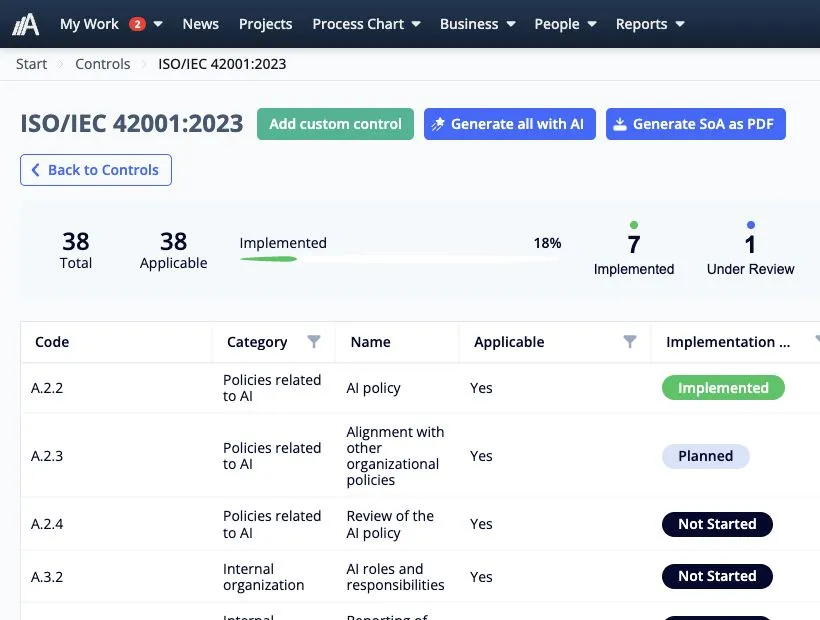
The organization appoints who records the AI system and intended use, assesses risks and impacts, decides whether the risk can be accepted, and follows up control status, review material, and outstanding actions. Controls can link to processes, risks, pages with approved policies and procedures, legislation, and equipment.
AI system and use case
You can configure the AI system register with fields for purpose, intended use, permitted data, owner, and affected process, and record the supplier and planned follow-up in the supplier register.
Risk and control
Use the risk module and a custom list to set up impact-assessment steps, owners, and decisions. Document applicability, status, ownership, and supporting material in the control register.
Nonconformity and follow-up
An appointed reporter records the nonconformity, the nonconformity owner assigns the action, and the action owner documents the result. Open nonconformities, action status, objectives, and measurements are compiled for management review.
AI assistance can draft a description of how a control will be implemented and followed up. Have the control owner review the draft against the approved policy and risk assessment before approving the text. Have a lawyer assess the organization's obligations under the EU AI Act separately.
Map your AI systems, assign responsibility, assess risks, and gather the material needed for the certification audit.
Map AI systems and AI use, define the scope, and document the relevant stakeholders, roles, and requirements.
Approve an AI policy, state which tools are approved and which data may be processed, and document who may approve use and which competence requirements apply.
Assess risks, follow up controls, and assign identified actions to owners.
Close the remaining gaps, complete an internal audit, and gather results, objectives, and measurements. AmpliFlow helps you prepare the material. A certification body conducts the external certification audit.
Every package includes AmpliFlow, system setup, file migration, templates, and an introduction to the software and templates. The difference is how much support you get with project leadership, internal audit, training, and adaptation. Every level requires management involvement and an internal owner.
You lead and carry out the work yourselves
For teams with an internal project lead that want to build the management system themselves on a ready-made foundation in AmpliFlow.
Included
You share project leadership with AmpliFlow
For teams that want to combine their own work with project leadership, internal audit, training, and help adapting the setup.
Included
AmpliFlow leads the implementation
For teams that want us to lead the implementation and adapt the system for an efficient way of working.
Included
Not sure which package fits? We recommend a level based on your current position, available time, and internal capacity.
Book a callYou do not need to prepare anything. We start with the AI systems in scope, the time your internal lead can set aside, and the support you need. Based on that, we propose Mini, Midi, or Maxi. After the call, you receive a quote with the proposed setup and price.