
Competence management
One of the critical factors in becoming a successful company is having the right people with the right skills in the right place.
Competency management involves identifying, developing, and retaining key competencies that are necessary to meet the organization’s goals.
The ISO standards emphasize the importance of ensuring that the organization has access to sufficient expertise. This applies to both existing and future needs.
To achieve this, the standards set specific requirements for how competence management should be handled within the organization.
These requirements include the following aspects:
Identify the necessary skills
The organization must identify the competencies needed to meet the requirements of the management system. This includes considering both technical and leadership competencies.
Assessment of competence
The organization must assess the existing skills of its employees and identify any skills gaps that need to be filled.
Documentation and follow-up
The organization should retain suitable evidence of competence and evaluate the effectiveness of actions taken to acquire necessary competence.
The next sections show practical tools for competence work and how they support business performance.
Competence matrix
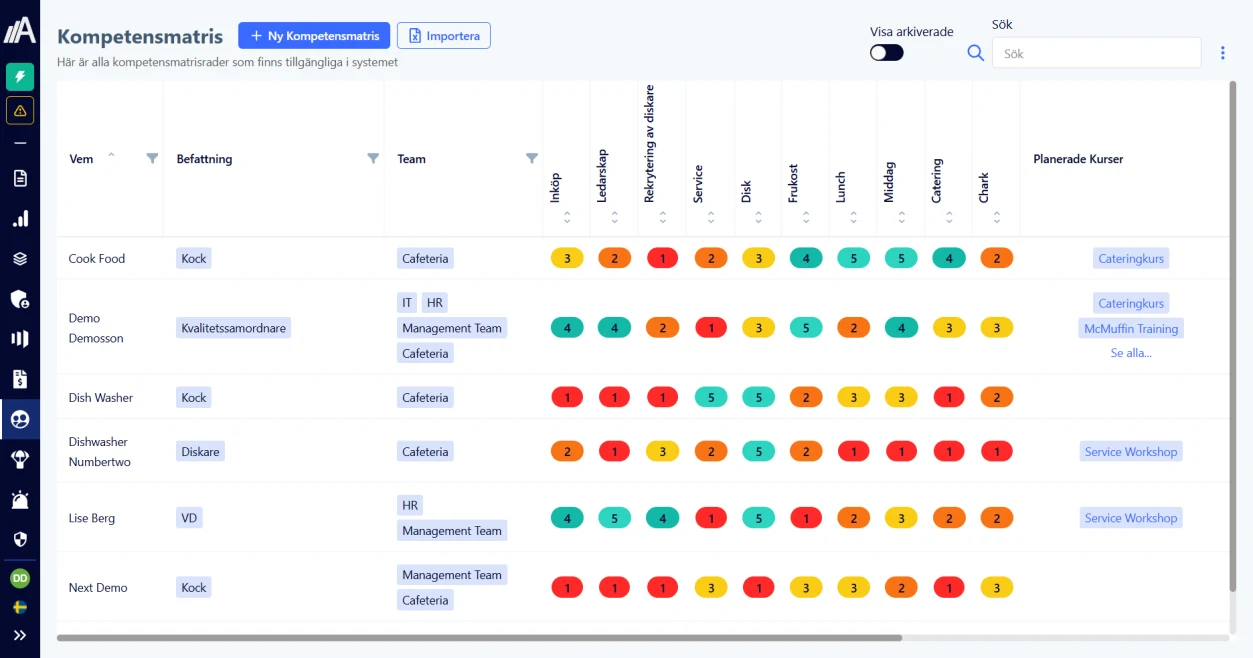
A competency matrix is a tool used to identify, organize, and communicate competencies within a company.
It usually consists of a tool (Excel, web tools such as AmpliFlow’s competence tool, etc.) with columns listing the competencies required in different areas of the organization and a row for each employee.
Each column represents a specific competency, and the ability to meet the competency is assessed with a number.
Leaders can use the competency matrices to identify which people are best suited to tackle specific tasks. They can also help them make more informed decisions about which people/skills need to be recruited, gain a better understanding of the types of competencies necessary to achieve a particular goal and plan for future development work.
Competence matrixes can be more efficient when used in smart IT systems where they are integrated into a digital management system with permission handling, visualization, etc.