
Goal management
Clear goals help leaders and employees see what should happen, who owns it, and how progress is measured.
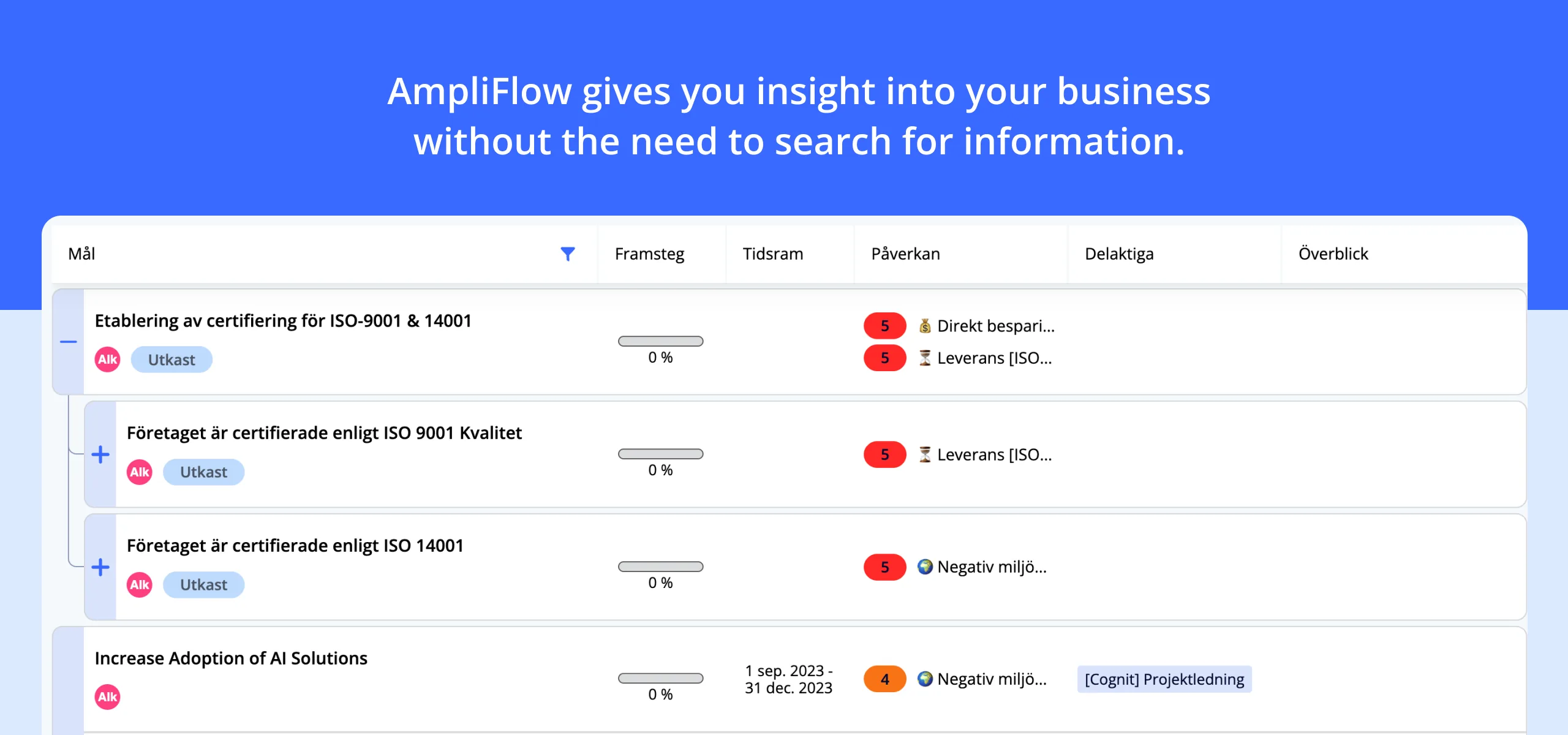
Objectives and goals create a basis for decision-making, resource allocation, and determining whether we succeed. It helps everyone in the organization work toward the same overall purpose and makes coordination easier. Good goals are also linked to the company’s vision and mission.
Goal management gives the organization a practical way to steer improvement work. By following these simple steps, you can create a culture of responsibility, commitment, and results while meeting the requirements of ISO 9001 and 14001.
In addition to including how goals are set, the goal management process should consist of a review and evaluation system to ensure that the objectives are met and that the company is on the right track to achieve its desired goals.
Goals can be SMART: specific, measurable, accepted, realistic, and time-bound. This will help you clearly define what you want to achieve and how you will know when you have done it.
Each management system standard in this guide requires objectives that fit the policy, can be followed up, are shared with the right people, are updated when needed, and can be evaluated. They should be measurable where the standard requires it or where it is practical:
-
ISO 9001 (Quality Management): Quality objectives must be established, documented, and consistent with the quality policy. These objectives should cover essential aspects like customer satisfaction, process improvement, and product conformity.
-
ISO 14001 (Environmental Management): The organization must set environmental objectives. They should support environmental performance, relevant compliance obligations, significant environmental aspects, and related risks and opportunities.
-
ISO 45001 (Occupational Health and Safety Management): Calls for establishing health and safety objectives that contribute to risk reduction, continuous improvement in occupational health and safety, and compliance with legal, regulatory, and other requirements.
Below is an example step-by-step approach to build goal management that supports the ISO requirements:
- Align goals with strategy
Begin by articulating your company’s strategic vision, mission, and commitments to quality, environmental responsibility, and employee safety. This alignment is essential because ISO standards require that objectives are consistent with your company’s overall policy.
- Set SMART goals
Specific, Measurable, Accepted, Realistic, Time-Bound (SMART). Ensure every unambiguous goal sets a clear target. For example:
-
Quality: Improve customer satisfaction scores by 10% within 12 months.
-
Environmental: Reduce energy consumption by 15% over the next three years.
-
Health & Safety: Reduce workplace incidents of severity grading three or higher by 20% within the next 12 months.
- Action plans
Assign clear responsibilities to teams and individuals. Your documented action plans should specify who is responsible for each goal, what resources are required, and the timeline for achieving them.
Confirm that necessary resources (financial, human, and technological) are allocated to support achieving these objectives. This is often examined during audits to ensure the goals are aspirational and actionable within the set timeframe.
Define how each goal will be measured. This allows the organization to quantitatively measure progress and determine how close you are to achieving your goals. A good practice is to set up multiple measurements that counterbalance each other.
Set up systems to collect the necessary data. Depending on your organization’s size and maturity, this may involve automated dashboards, periodic surveys, or manual data collection.
Schedule regular internal audits and management reviews to support compliance evaluation and improvement. These reviews should assess progress against the set objectives and determine if further action is required.
- Celebrate achievements
When an objective is met, celebrate these achievements. Recognition helps reinforce the goal-driven culture and motivates teams.
A culture of continuous improvement not only boosts compliance with the standards but fosters an environment where employees are engaged and committed to the organization’s mission.
Once objectives are achieved, review the lessons learned and set new, more ambitious goals to drive further improvements across quality, environmental performance, and health and safety.
By integrating goal setting, monitoring, and review practices into the daily operations, you create an environment where everyone knows what is expected and where you can objectively measure and improve over time.