
Risk management
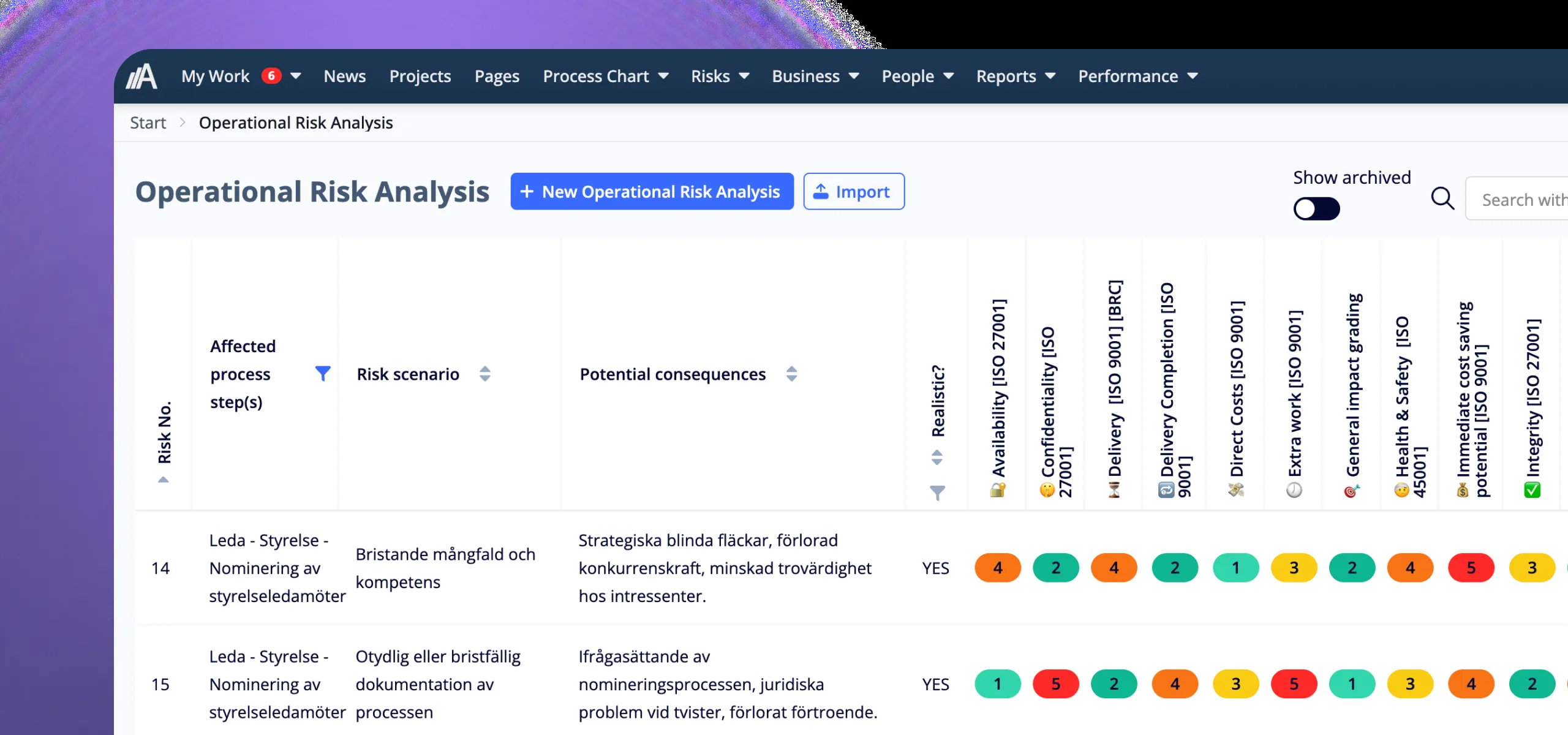
Working with systematic risk management helps you identify, analyze, assess, manage, and follow up risks that may affect the company. It is an effective way to prevent problems and improve results.
Risk management is like the brakes on a car. The function is to slow down, but the purpose is to let us drive fast. In ISO work, risk is the effect of uncertainty on results. It can be a threat to reduce, but it can also be an opportunity you want to use.
By anticipating, identifying, and managing risks, you can prevent problems before they occur.
To succeed with risk management, you need to identify potential risks, evaluate them, develop action plans to manage them, and, of course, follow up on them regularly.
You also need to ensure that the necessary resources are in place to manage risk, protect customer interests, and adapt processes to changing market conditions and customer needs.
At the same time, we need to consider the company’s benefits of risk management. Remember to think from the perspectives of “we as a company,” “me as a leader,” and “me as an individual.” If we cannot link the work to these three areas, achieving significant effects won’t be easy.
If we have learned anything from Covid, everything can change overnight. That makes preparation useful.
ISO 9001 is based on a concept called risk-based thinking. In short, risk-based thinking means planning and taking measures to manage risks and opportunities, which means working systematically with risk management.
When you identify a risk, you need to properly assess it by following the checklist below. If you repeat this and find a systematic approach to the work, you will be well-equipped to succeed.
-
Define the risk scenario
-
Identify potential consequences
-
Determine if the risk is realistic
-
Grade the risk according to a severity or impact matrix
-
If you use risk numbers: calculate a risk number
-
Identify measures and set an action plan to reduce the risk
-
Assign responsible
-
Set a deadline for managing the risk
-
Follow up whether the action has changed the risk picture, for example with an updated risk number if you use that method