
Process mapping
Process charts are typically the result of process mapping and are used to visualize the company’s processes.
All companies have processes. Management system ISO standards require you to understand and control the processes needed for the management system. Process mapping is a practical way to show that work. A process mapping aims to identify, analyze, and improve the processes necessary to achieve the company’s goals.
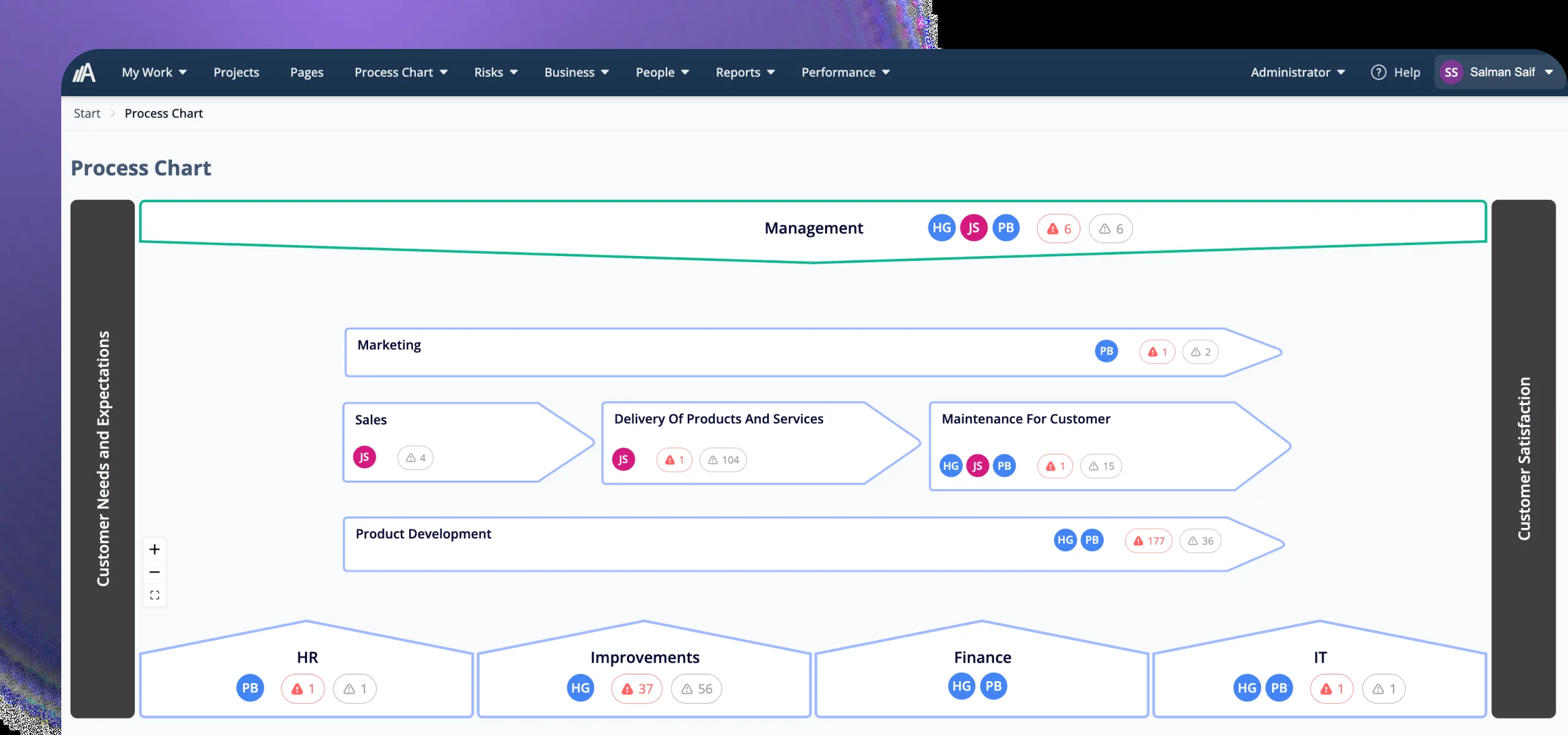
A process is typically defined as several standalone or interacting steps to achieve a goal. This can involve collecting data, analyzing information, making decisions, acting, and following up on the results. Simply put, a process takes inputs and converts them to outputs.
More formally, it can be described as SIS does:
A process is a set of interrelated or interacting activities that use inputs to deliver an intended result.
NOTE: Inputs and outputs may be tangible (e.g., materials, components, or equipment) or intangible (e.g., data, information, or knowledge).
We usually say that the processes are what transform your customers’ needs and wishes into satisfied customers. Organizations that understand and manage their processes as a complete system can become more efficient and better achieve their goals.
Process work helps you manage and improve processes so they support the organization’s policy and direction. With a complete understanding of the company’s processes, we can see how they can be improved to reduce costs, increase efficiency, and meet customer expectations.
One thing that is sometimes forgotten is that a process chart is the perfect tool to ensure that everyone can understand, or at least know where to find, how the company works. They are excellent tools for onboarding or when major organizational changes are implemented.
To perform a process mapping and create a process chart you:
- Visualize your processes to get a better understanding of their steps and activities
- Identify which processes are essential/high-risk
- Understand which activities in the processes are critical to achieving the company’s goals
- Identify potential risks
- Identify how the processes can be targeted and followed up
- Analyze and work with effective deviation management to find improvement opportunities
It doesn’t have to be as complicated as you might first think, but it does require experience to know how to efficiently perform a process mapping exercise.
Our experience tells us that companies often provide too much detail when performing process mapping for ISO 9001 certification.
It is important to identify the steps relevant to meeting the requirements, but at the same time, make sure that you do not add unnecessary information that does not support the company’s goals or is at too low a level. You will get audited on what you show, so don’t show more than you need to.
Process mapping is often done with tools that create flowcharts and swimlane diagrams to visualize the processes and clarify their steps. AmpliFlow has tools for process mapping that help you create process charts that show steps, responsibilities, and links between processes.
The choice of tools can sometimes become a headache because we must involve IT, but here’s our advice: think simply and don’t overdo it.
Process mapping within ISO 9001 is a useful way to show processes, interactions, responsibilities, and controls in the quality management system, but do not forget the big picture and simplicity.