
What is a severity matrix?
A severity matrix (or impact grading matrix as we prefer to call it) is a tool that helps organizations quantify and rank, for example, risks, deviations, suggestions for improvement, and other things that are managed within the framework of a management system. By using the matrix, companies can assess the consequences and possibilities of different events or ideas.
This provides a clear and objective basis for making decisions and priorities.
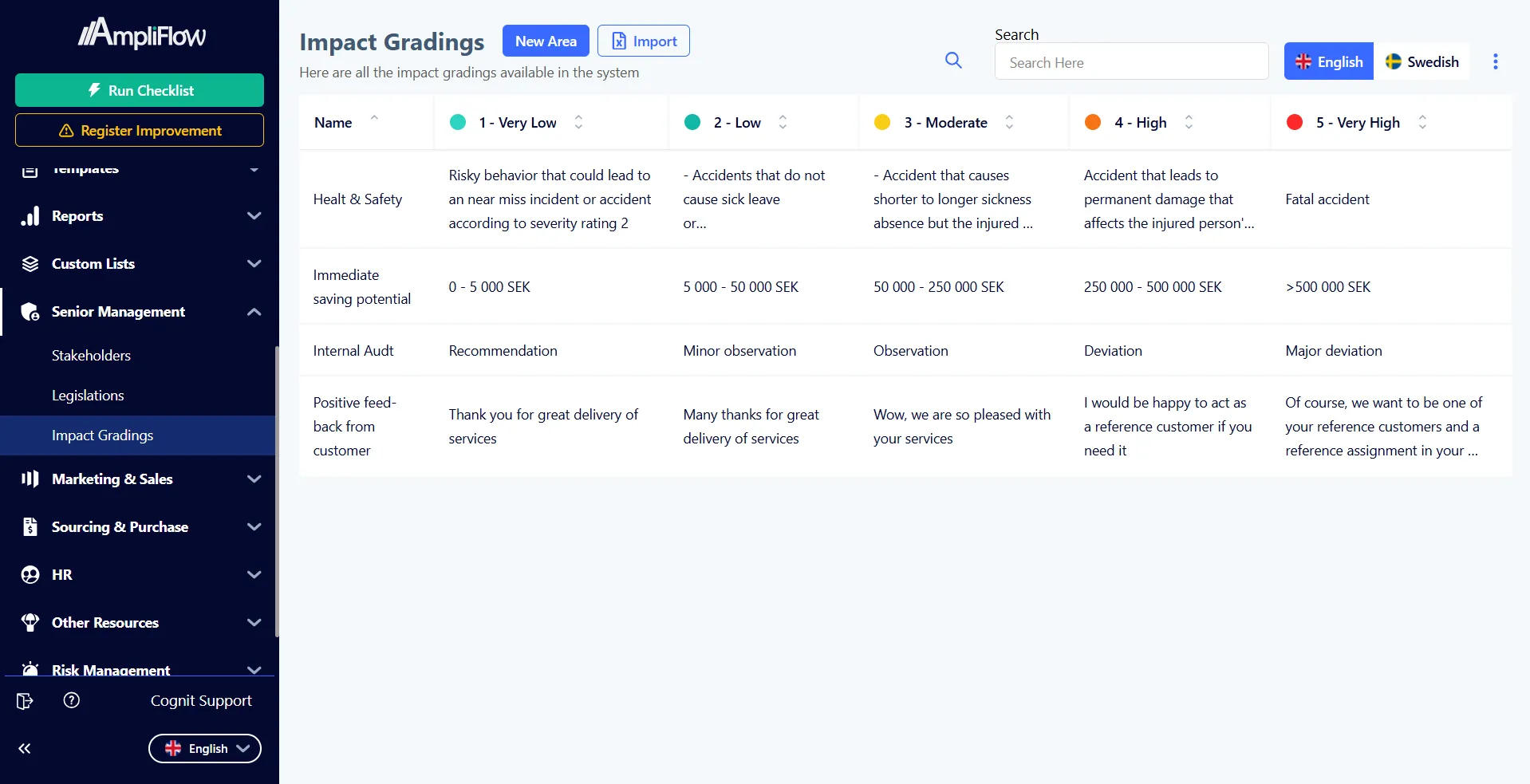 Impact grading matrix in AmpliFlow
Why use a severity matrix?
Advantages of the matrix
- Objective assessment: Provides a structured method for comparing different risks and anomalies.
- Clear priorities: Helps identify which problems require immediate action.
- Increased efficiency: Saves time and resources by focusing on the most critical issues first.
- Improved communication: Facilitates discussions about risk management and quality work.
Areas of application
- Risk management: Assessment of the impact and likelihood of potential risks.
- Deviation management: Prioritization of deviations based on their severity.
- Suggestions for improvement: Comparison of different proposals to determine which ones provide the most value.
- Customer complaints: Evaluation of complaints to determine how best to deal with them.
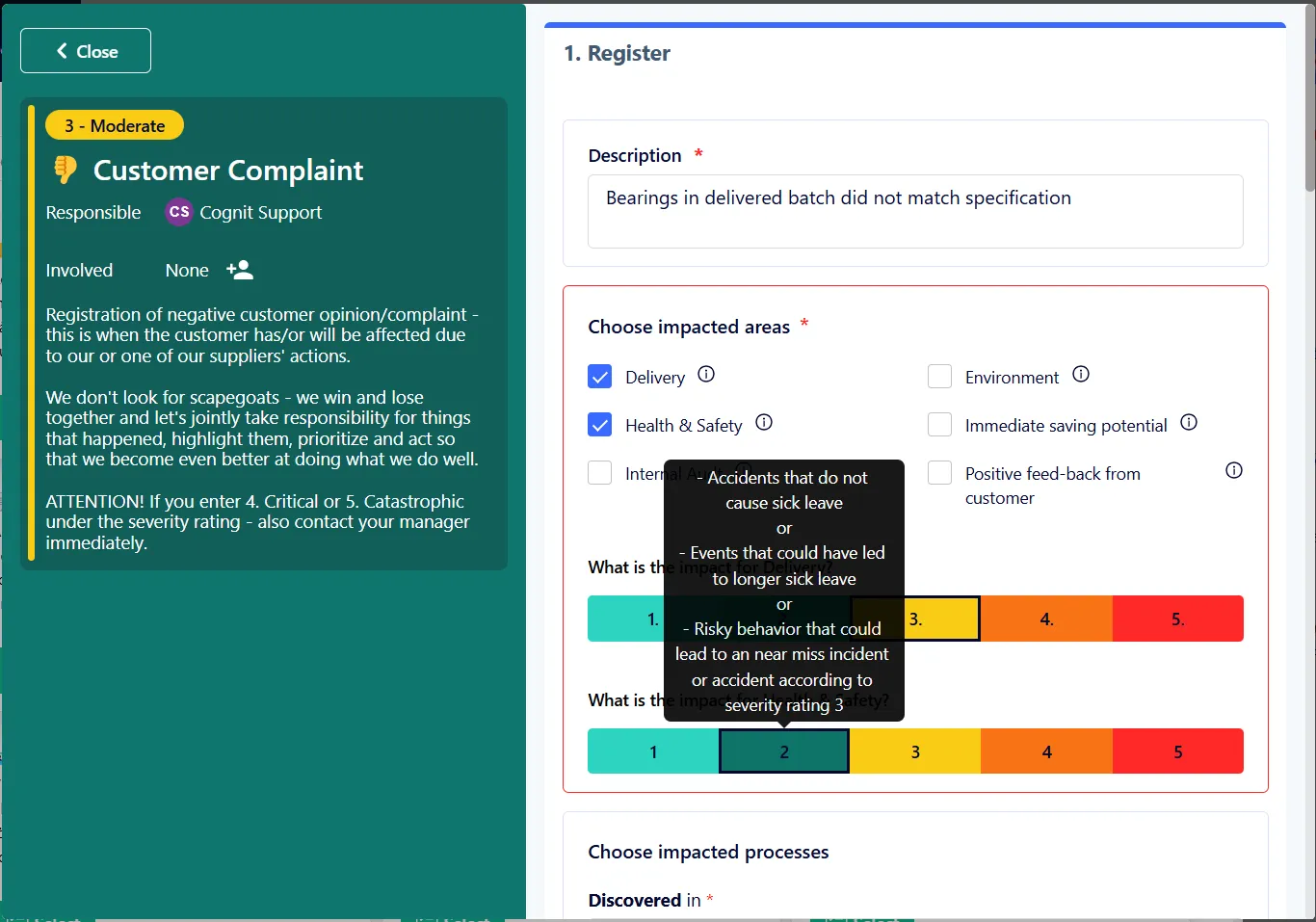 Classification based on several areas in the registration of a customer complaint
How to create a severity matrix
To create an effective severity matrix, it is important to have a clear process that ensures all relevant factors are considered. By following these steps, you can build a structure that helps your organization identify, evaluate, and manage risks in a systematic way.
Steps to develop the matrix
- Identify areas: Start by listing all the areas you need to classify potential risks, anomalies and suggestions for improvement.
- Assess consequences: Evaluate the potential impact of each risk or deviation on a 5-point scale.
- Cover the big picture: Make sure to cover the entire business, it may make sense to gather input even outside the management team.
- **Educate the staff: **To have an effect, it needs to be a tool that the entire organization uses.
Factors to consider
You need to consider the areas that are relevant to you. Below is a list of a few examples you can start from.
- Economic costs: Direct and indirect impact on the company’s finances.
- Time investments: The time required to fix the problem.
- Environmental impact: How the problem affects the environment.
- Customer feedback: Customer feedback and complaints.
- Personal safety: Potential risk of personal injury.
Advice for implementing a severity matrix
- Understand the purpose: Clarify why the matrix is important for your business.
- Invest time and effort: Be prepared to put effort into developing and implementing the matrix.
- Collaborate with experts: Use external expertise to ensure the best possible results.
- Educate your team: Make sure everyone understands how to use the matrix.
- Use continuously: Integrate the matrix into daily work to maximize its utility.
- Update regularly: Adapt the matrix according to changes in the business.
Conclusion
A severity matrix is a valuable tool for managing the right risks and anomalies. By taking the time to develop and implement a matrix, companies can not only reduce the risk of costly errors, but also increase their efficiency, productivity and competitiveness.
Are you ready to take the step towards a more structured and efficient business? Contact us at AmpliFlow to discuss how we can help you create a severity matrix that fits your particular business.